
Not fit enough on one side. Too much on the other. Somehow both at once.
Build real strength in 8 weeks. At home, three sessions a week, with nothing to buy.
A calisthenics method built for your physiology and a full life. Not a men's program repainted.
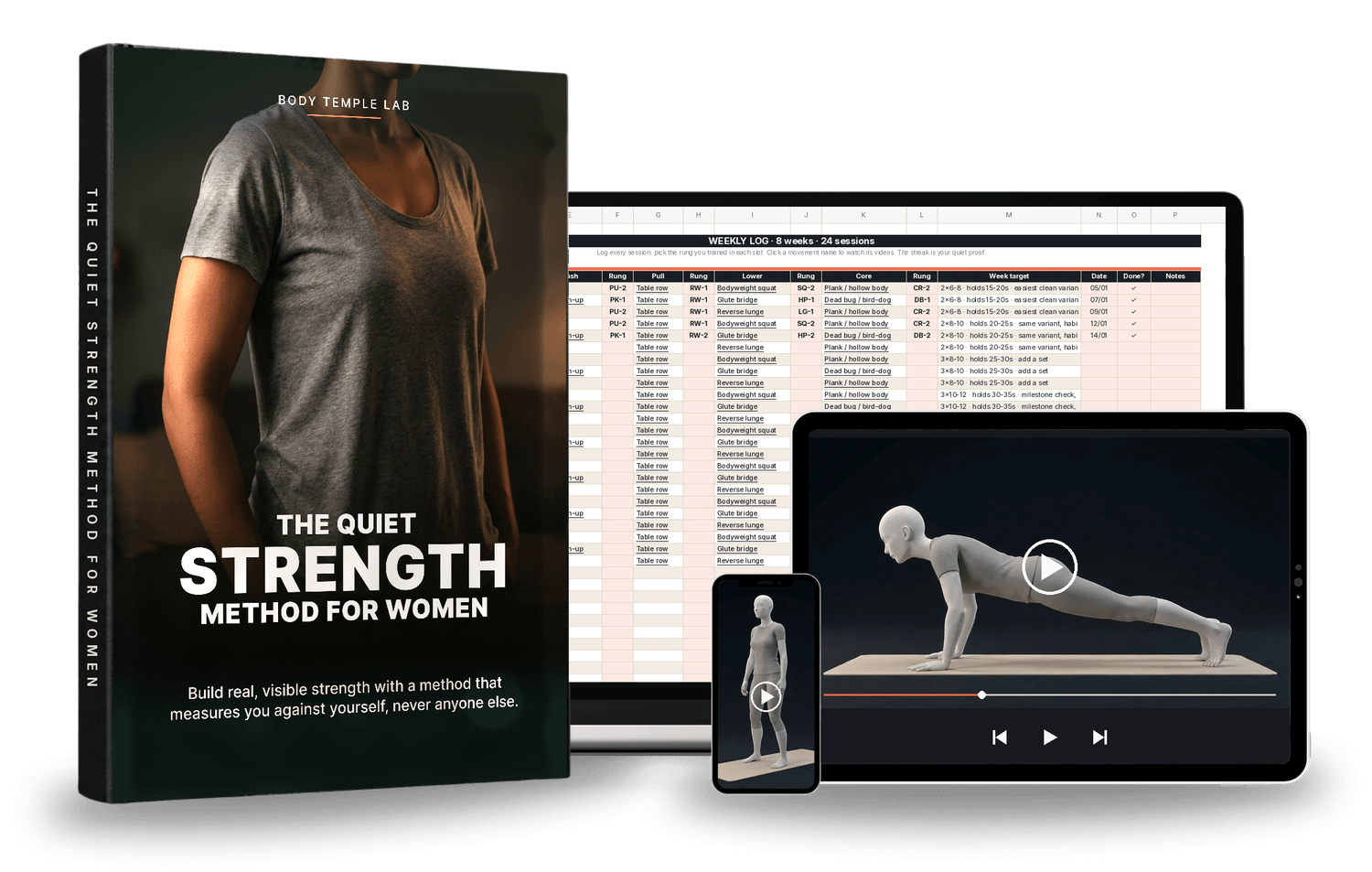
30-day money-back guarantee. No countdown, no discount clock. Just the eight weeks, on your own terms.
Which version of you were you supposed to be?
It isn't a discipline problem. It's a scoreboard problem. You've been handed two standards at once, and they contradict each other: get in shape, but don't get too strong. Look after yourself, but don't take up space doing it. No amount of willpower resolves a rule you can't satisfy from either direction.
“I sometimes feel like I can't win.”
There is a way out of the bind, and it isn't picking a side. It's changing what you measure. Strength and capability, measured against your own baseline, and no one else's eyes.
Same effort. Different scoreboard.
- A men's program with the colors changed
- “Tone up, but don't get bulky”
- Depends on motivation, quits when willpower dips
- Needs a gym, or equipment you have to buy first
- Progress judged in the mirror, or by comparison
- Advances on the calendar, whatever your form looks like
- Built around female physiology, and it explains the why
- Get strong. The bulky fear is answered with the actual endocrinology, not reassurance
- Runs on a system. Consistency by design, with a floor for bad weeks
- Needs a floor and a sturdy table. Nothing to purchase
- Progress measured in your tracker, against your week-one numbers
- Advances only when your form is clean. The gate is the movement, not the date
Everything the method needs. Nothing it doesn't.
One method, seven tools, zero guesswork.
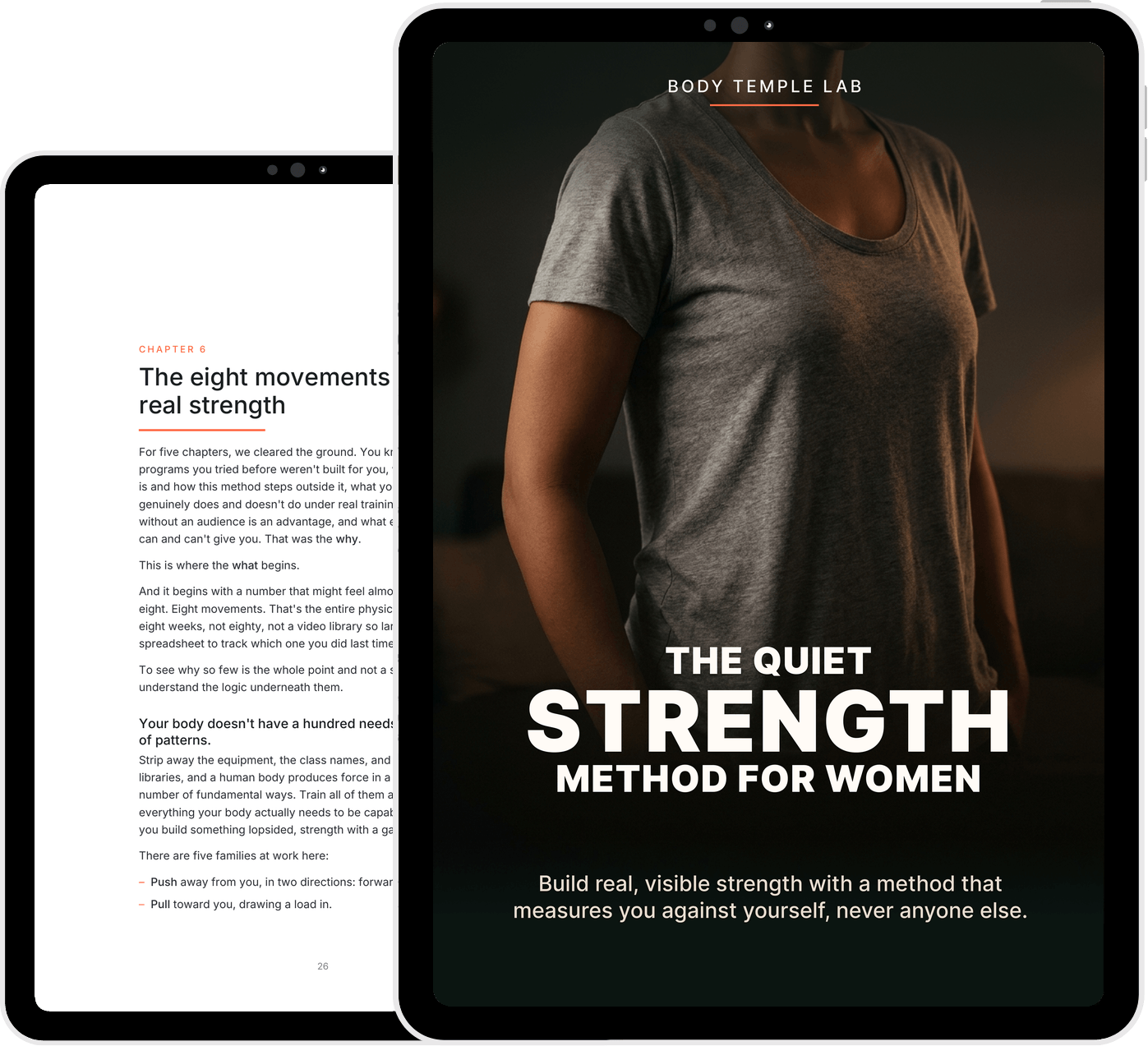
Your eight weeks, laid out day by day
Thirteen chapters, eighty-four pages, two phases. Foundation, then Strength Build. Every session and progression written out, so you never open the app of your own willpower to decide what's next.
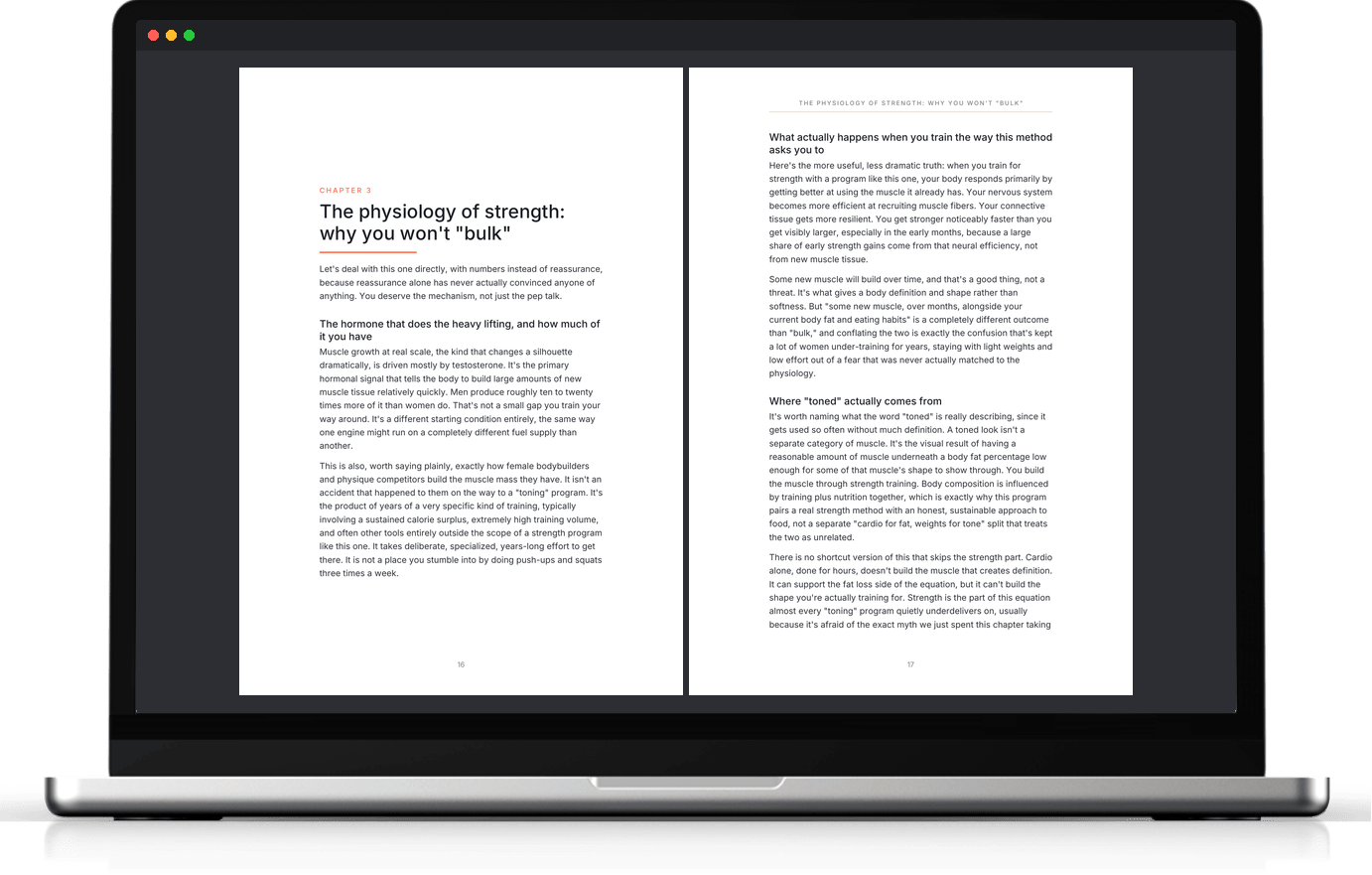
The physiology, explained instead of promised away
The chapter that answers the bulky question with the actual hormonal arithmetic, so you stop needing to be reassured about it.
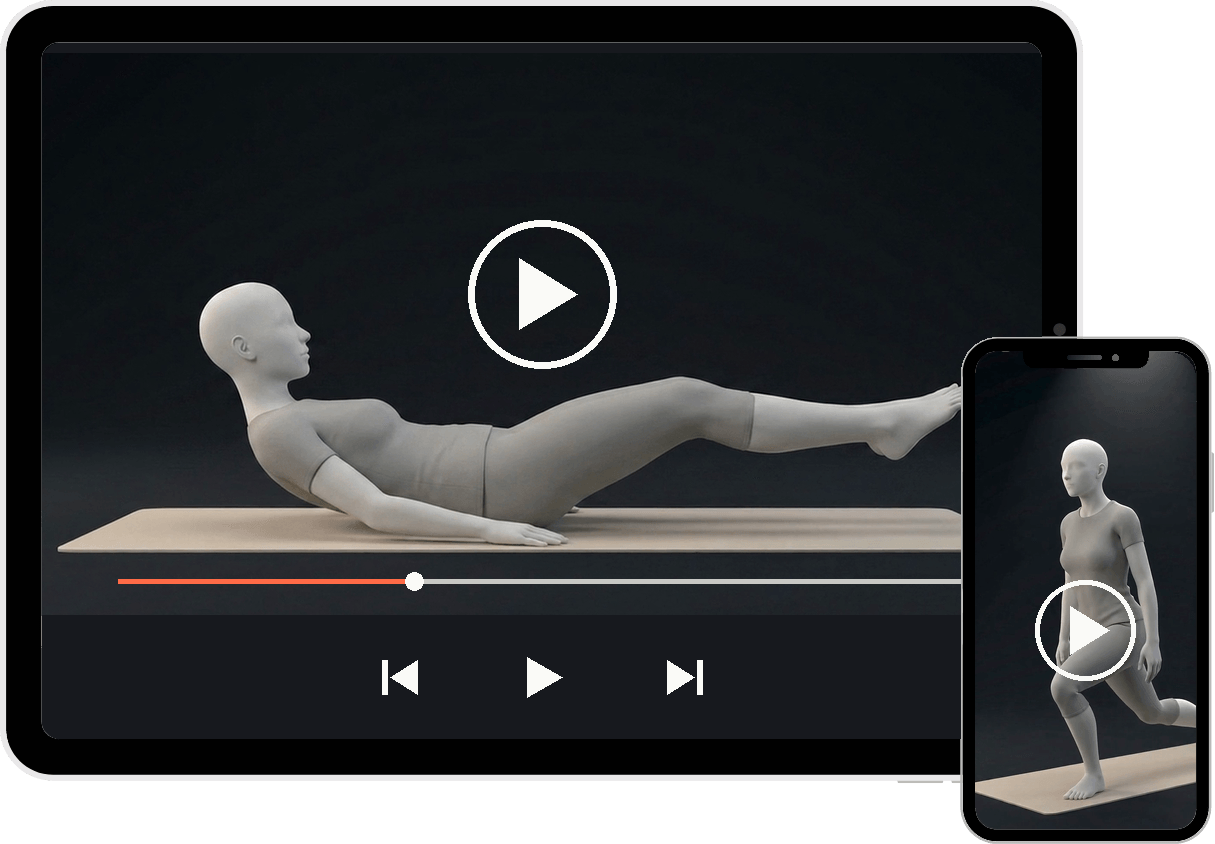
Never wonder whether your form is right
Twenty-six reference clips across all eight movements and every progression, filmed to show exactly what clean looks like.
See your progress before you see it in the mirror
A four-tab tracker: baseline, weekly log, dashboard, and a full week-eight retest. Proof instead of impression.
The eight movements, always in view
A printable wall chart with a pictogram for each movement and its progressions. Glance and go.
Start your first session without deciding anything
A one-page walkthrough for your first twenty minutes. Zero decisions to make while you're still deciding whether to start.
Eat for the training, without a diet
A free nutrition appendix inside the book. Principles, portions, protein. No calories to count, no foods to weigh, nothing to buy.
This method was built for a specific woman.
- You want serious muscle mass, or to compete.
- You want a different body in two weeks, without eight weeks of structure.
- You can't commit 20 to 25 minutes, three times a week.
- You want a live coach, or a community to check in with, instead of a method you run yourself.
30-day money-back guarantee. Instant access.
There is no group. That is the point.
No community to join. No check-ins, no shared feed, no photos of anyone's progress next to yours. Every program that adds a group also adds an audience, and an audience is the thing you were trying to get away from.
What replaces it is the tracker. Eight weeks of evidence in your own handwriting, measured against one person's numbers. Yours, from week one.
$82 of method. Plus 4 free bonuses.
Today, $27.
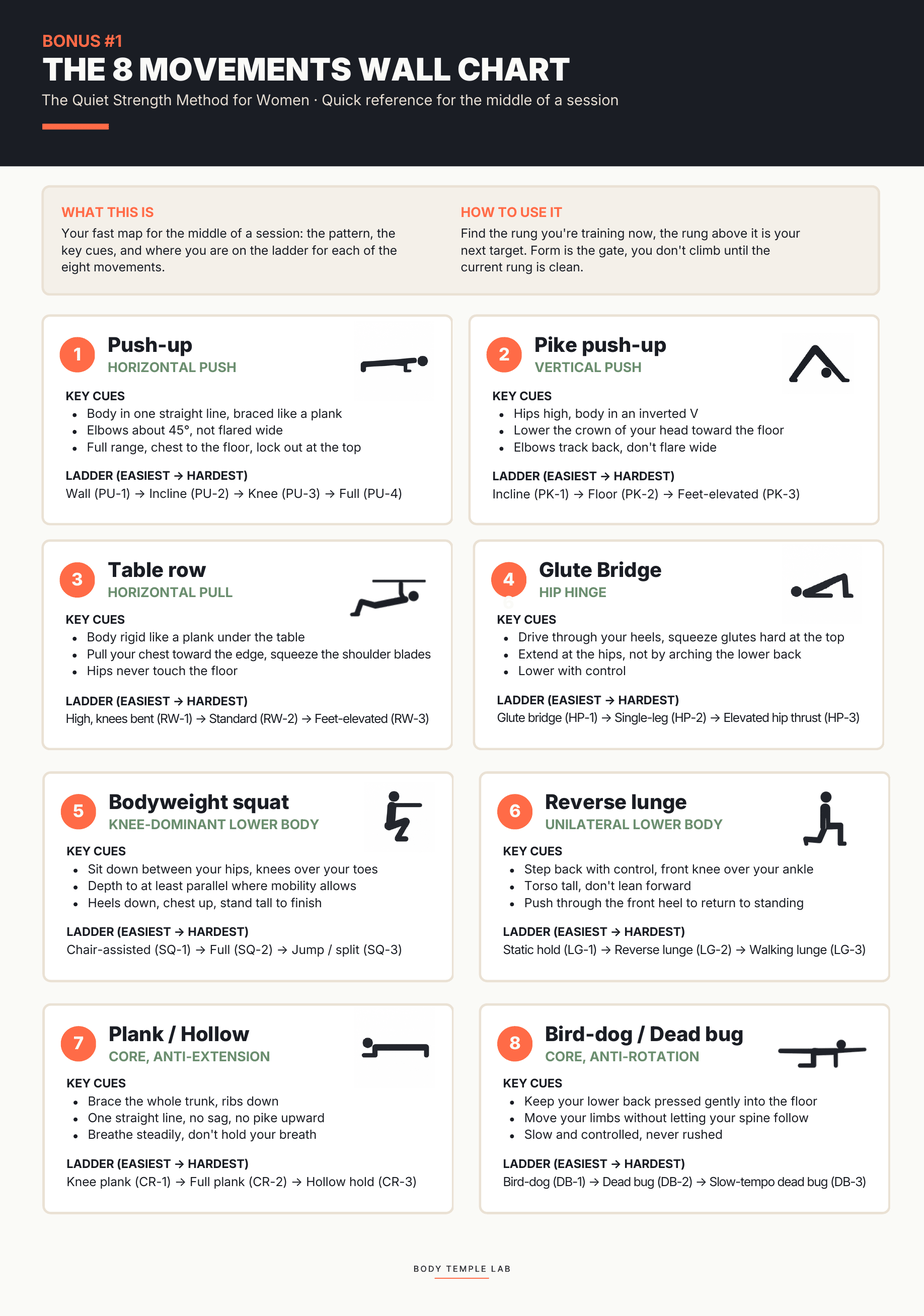
The 8 Movements Wall Chart
A printable reference for all eight movements and their progressions, with a pictogram for each. Keep it where you train.
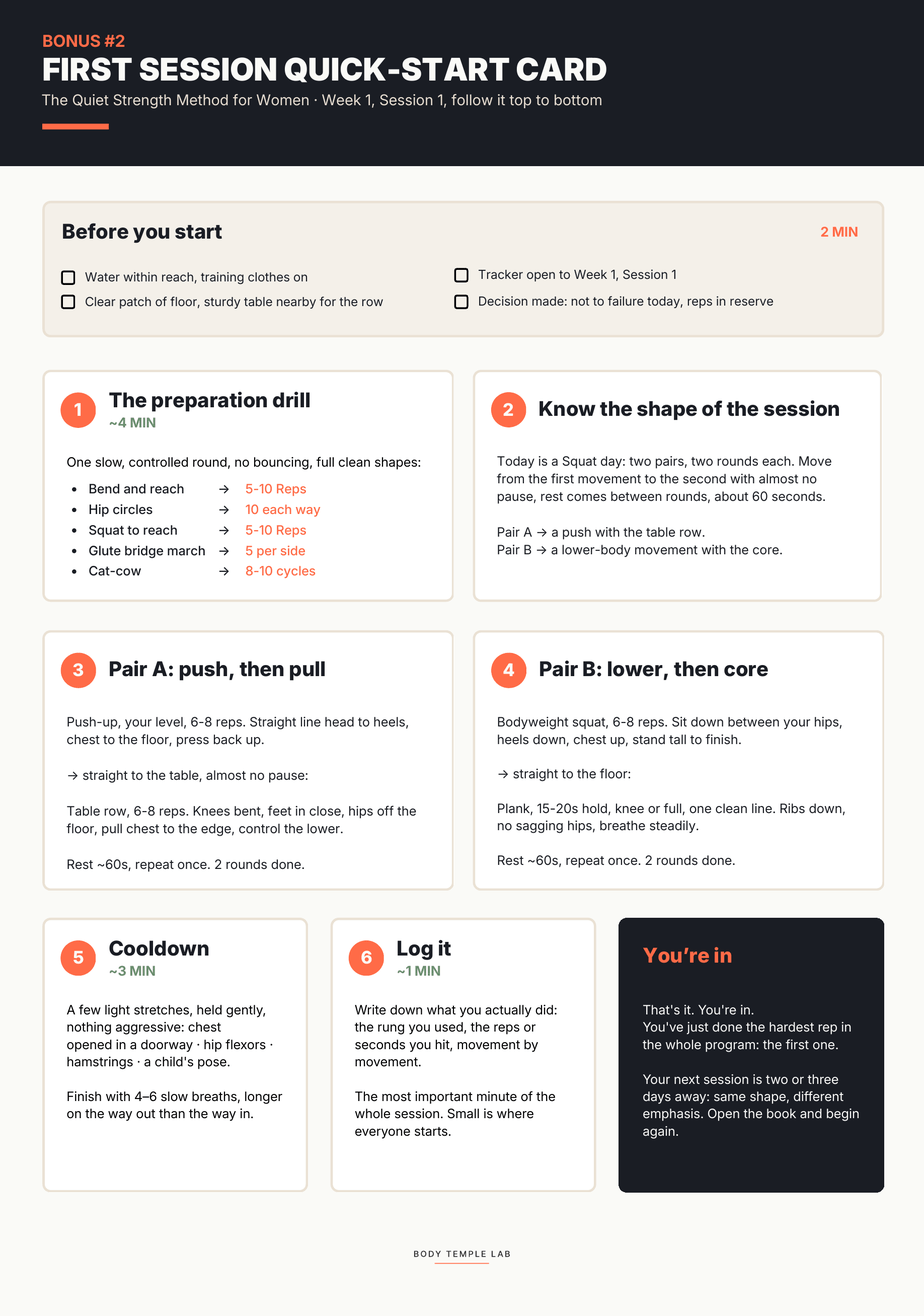
First Session Quick-Start Card
Your first twenty minutes on one page, so the first session starts without a single decision to make.
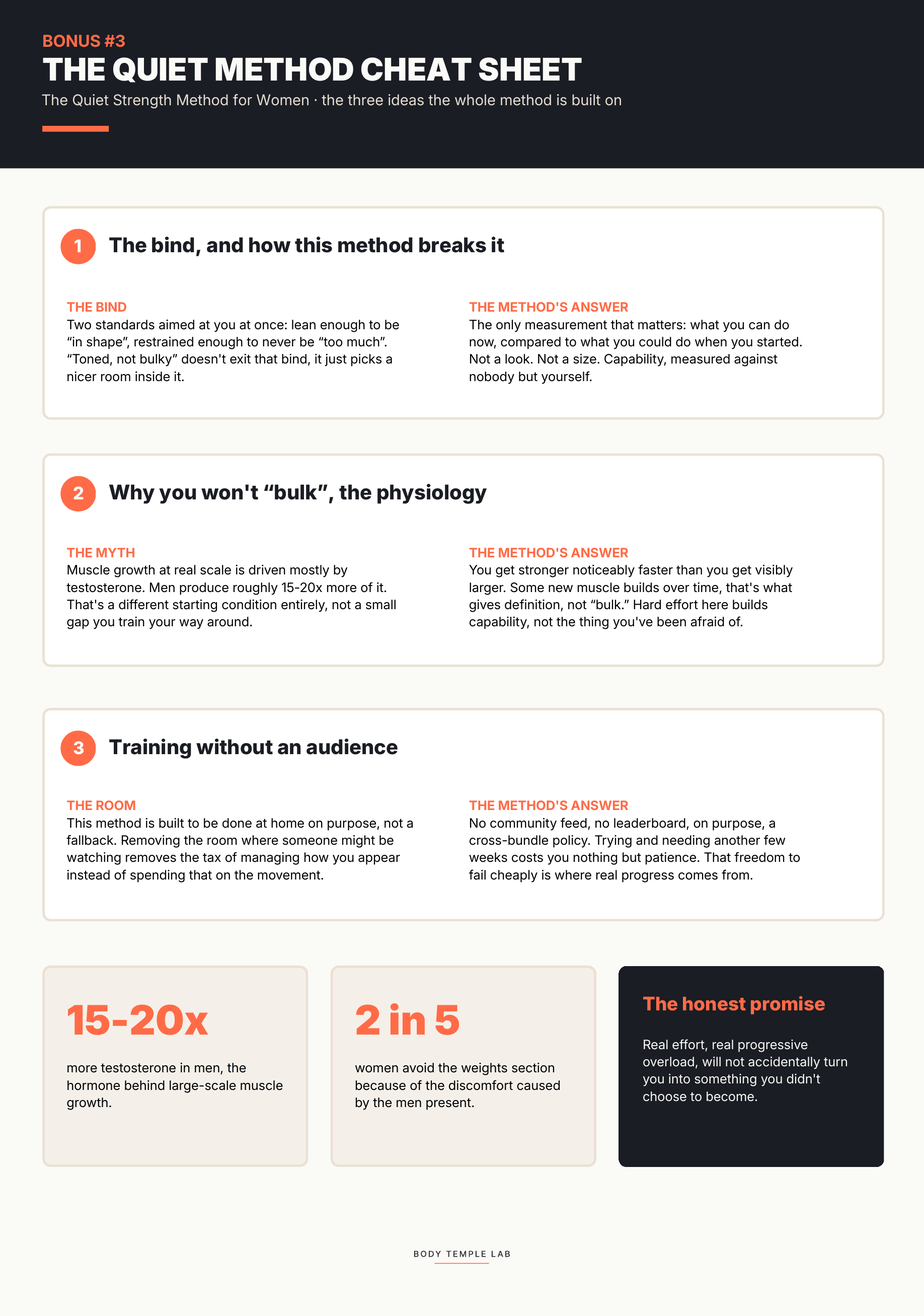
The Quiet Method Cheat Sheet
The bind, the bulky myth, and the training-without-an-audience rule, on a single page. The three things worth keeping in view.
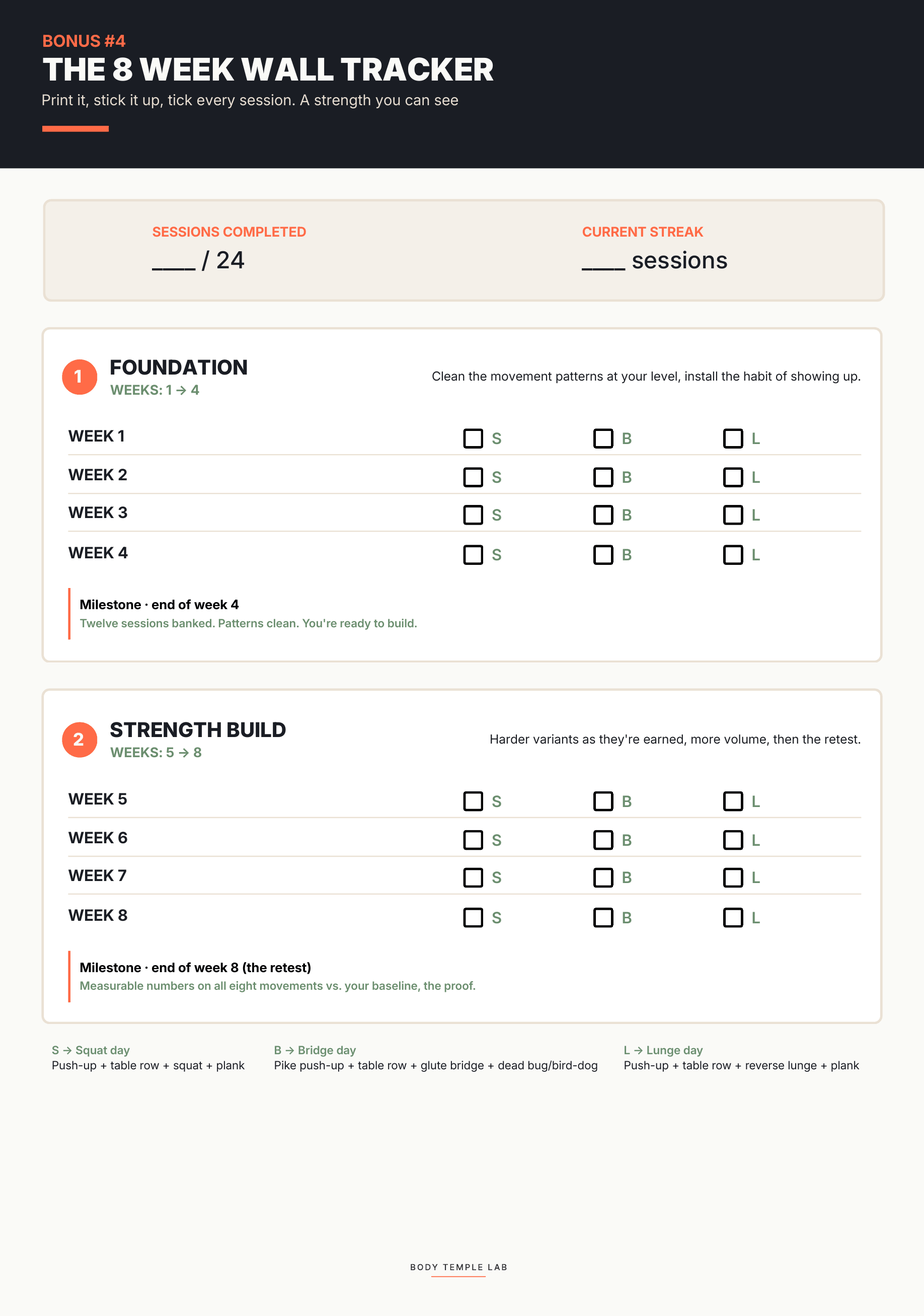
8-Week Wall Tracker
A printable, checkable version of your eight weeks. For the fridge or the wall, in plain sight.
Not written for marketing.
Written to us, months before this page existed.
Before any of this was for sale, we gave the full eight-week method to a small group of women we know. These are their own emails, translated from Italian. First names, nothing else.
“I'd always been afraid that bodyweight or strength training would make me bulky, or muscular in a masculine way. This book explained exactly why that doesn't happen, and that's what gave me the confidence to start. After eight weeks I feel toned, strong and defined, and the back pain from sitting at a desk is finally gone.”
“I have two children and a full-time job. I don't have two hours a day for a gym, and I don't want to feel watched in the weights room either. Training at home, twenty-five minutes, no audience, with a clear plan so there's nothing left to decide in the evening, that was the real turning point. My clothes fit differently and I have energy I haven't had in years.”
“I thought I wouldn't get real results without equipment or complicated machines. The progression across the eight movements is calibrated really well. I started from the easiest variations and got to full push-ups and the pulling work with clean form. Feeling like I'm in charge of my own body again is priceless.”
Personal experiences shared by early practitioners. Individual results vary with starting point and consistency.
Not a trend. A physiology, and a study.
“We didn't invent a feeling. We read it in a study of 279 women, and built the method that answers it.”
The method starts from published research, not from a marketing angle. A 2025 peer-reviewed study in PLOS ONE interviewed 279 women about strength training and surfaced the contradiction at the center of this program: judged for not being fit enough, and judged for the risk of becoming too much. The physiology chapter answers the bulky question with the endocrine reality, a testosterone gap of 15 to 20 times, which is why eight weeks of bodyweight training builds strength and capability rather than size. Eight movements, no equipment to buy, and a progression gated by your form instead of the calendar.
Why $27, not $82?
It's priced to put a complete method in as many hands as possible, not to maximize one sale. Everything here works standalone, including the nutrition principles. Nothing is held back to force a second purchase later.
Launch price. Going up soon.
When this opening phase ends, the price returns to $82, which is what the method is worth. Backed by a 30-day money-back guarantee, so trying it costs you nothing except the decision to start.
Here's what you get.
- The Quiet Strength Method for Women. Ebook + 8-week program $34
- Quiet Strength Tracker $19
- Movement Library. 26 clips $29
- 4 free bonuses. Wall Chart, Quick-Start Card, Cheat Sheet, Wall Tracker Included
Not promises. Built-in milestones.
The book has a chapter on what eight weeks can and cannot do, and it's there before you buy anything else.
What it can do: you get stronger in a way you can measure, not just feel. The progression you start on in week one very likely feels easier by week four. Your plank extends, your squat depth and control improve, your form on the row cleans up.
And it usually shows in your day before it shows in the mirror. Stairs stop registering as anything. Carrying something heavy up from the car stops being a decision. Getting up off the floor happens without a second of preparation first.
What it can't do: undo years of sitting and hand you a different body in eight weeks. Nobody can, and the book says so on the page instead of in the small print.
Straight answers.
You already know which scoreboard you want to stop playing on.
Eight weeks. Eight movements. One method, measured against you.
Start The Quiet Strength Method. $27